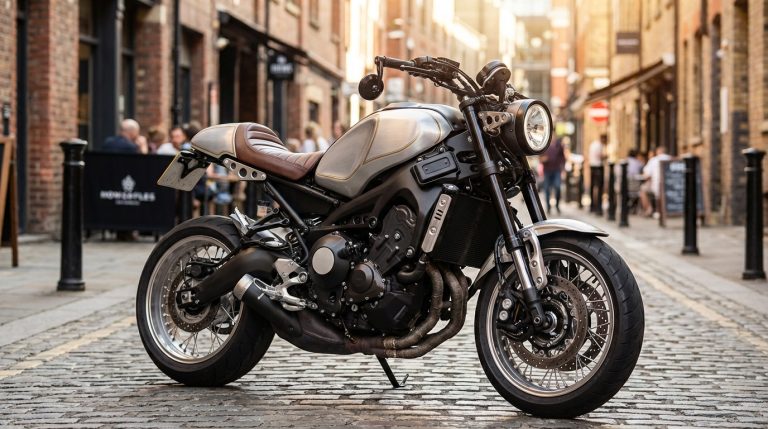
Moto Guzzi history since 1921

For over a century, Moto Guzzi has stood out as an iconic figure in Italian motorcycling, embodying technical innovation, bold design, and a deeply rooted tradition. Founded in 1921 in Mandello del Lario, the brand with the famous outstretched eagle has traversed the ages with a unique blend of creativity and performance, building a true motorcycling heritage. Moto Guzzi’s history is punctuated by legendary models, groundbreaking innovations, and sporting forays that have contributed to forging its aura. This article dissects this eventful saga, revealing the keys to its success and the major milestones that have made Moto Guzzi a must-have in the world of two-wheelers.
Over the decades, the brand has successfully combined technical rigor and passion, notably linking its famous V-twin engine with a constant drive for adaptation. The evolution of its motorcycles reflects a skillful balance between respect for tradition and the pursuit of innovation, as well as an unwavering commitment to motorcycle racing and sporting performance. Now part of the Piaggio Group, Moto Guzzi retains its unique character through a strong commitment to design and mechanical development, particularly with modern models adapted to the most stringent standards. The Moto Guzzi heritage is thus an invitation to discover a saga rich in emotion and achievement, a living testament to the Italian spirit.
The origins of Moto Guzzi: a heritage rooted in Italian history
The origins of Moto Guzzi date back to March 15, 1921, the official founding date of the company in Mandello del Lario, on the shores of Lake Como. This location, which remains the brand’s heartland to this day, witnessed the birth of the initial ideas and passion of its founders: Carlo Guzzi, Giorgio Parodi, and Giovanni Ravelli. Their shared experience in the Royal Navy’s air service left an indelible mark on the brand’s identity. In homage to their fallen comrade, Giovanni Ravelli, they decided to adopt the symbol of the outstretched eagle, an emblem that has become legendary and embodies freedom, power, and elegance.
The post-war context presented a significant challenge: meeting the growing demand for robust and innovative machines capable of handling often difficult roads. The first Moto Guzzi, nicknamed “La Normale,” was produced between 1921 and 1924 and laid the foundation for a long line of twin-cylinder and single-cylinder motorcycles that would come to characterize the brand. A major innovation was quickly implemented with the construction of a wind tunnel in the 1930s – an unprecedented advancement in the global motorcycle industry at the time, highlighting the company’s pioneering approach.
Moto Guzzi’s involvement in motorcycle racing began early, with several world titles won between 1935 and 1957, thanks to machines ridden by champions and designed by iconic engineers like Giulio Cesare Carcano. Carcano notably conceived the famous “Eight-Cylinder” engine capable of reaching impressive speeds for the time (up to 285 km/h in 1955). This technological gamble illustrated Moto Guzzi’s constant desire to push the boundaries, combining performance and design, while placing racing at the heart of its history.
The technical evolution and flagship models of Moto Guzzi through the decades
After the war, the brand managed to capitalize on the period of economic reconstruction to launch models that would become lasting market staples. The Galletto, launched in 1950, perfectly illustrates this era: a light and versatile motorcycle that enjoyed massive success thanks to its comfort and robustness, becoming a post-war icon. More broadly, the 1950s and 60s marked the rise of the 90° V-twin engine, an architecture that became the aesthetic and mechanical signature of Moto Guzzi.
This engine has appeared in several iconic models, including the V7 And the California, symbols of traditional craftsmanship combined with modernity. Shaft drive, another technical feature, enhanced the motorcycles’ reliability while reducing maintenance, appealing to endurance and long-distance riding enthusiasts. This system remains relevant today, with improvements that make it just as powerful and efficient on modern models.
The 80s and 90s saw the integration of new technologies, including electronics and Euro 5 regulatory adaptations to meet the latest environmental standards. Among the innovations were motorcycles like the V9 Roamer illustrate this alliance between tradition and innovation. In parallel, Moto Guzzi explored different segments, from off-road motorcycles with the Stelvio 1200 NTX to sport bikes with the Griso 1200, proving once again the diversity of its range.
The table below provides an overview of the iconic models and their distinctive features:
| Model | Launch Year | Main Feature | Engine Type |
|---|---|---|---|
| The Normal | one thousand nine hundred twenty-one | First production motorcycle | Single cylinder |
| Galletto | one thousand nine hundred fifty | Post-war multipurpose motorcycle | Single-cylinder 2-stroke |
| V7 Special | one thousand nine hundred sixty-seven | First 90° V-twin engine with shaft drive | V-twin |
| California | one thousand nine hundred seventy-one | Touring with premium comfort | V-twin |
| V9 Roamer | two thousand seventeen | Retro-modern motorcycle, easy to access | V-twin |
The V-twin engine: the beating heart of Moto Guzzi innovation
The V-twin engine, often called a V-twin, is not just a technical element at Moto Guzzi: it’s a true symbol of identity. Its 90° V-twin architecture, combined with shaft drive, has made it possible to combine robustness, torque, and reliability—essential qualities for a motorcycle designed for both road use and competition. This iconic engine has evolved with technological advancements, incorporating modern electronic controls to optimize performance and comply with current Euro 5 regulations.
This ingenious design also provides riders with a particular pleasure, renowned for its distinctive sound and torquey character. The flexibility and power of the V-twin engine make riding both dynamic and safe, perfectly meeting the expectations of modern motorcyclists. The influence of this engine can be seen in several recent models, including the Stelvio 1200 NTX which combines power and versatility, and in the sportiness displayed by the Griso 1200.
This technology, the result of decades of refinement, embodies Moto Guzzi’s ability to fuse tradition and modernity. It not only meets mechanical needs but also an aesthetic vision where design is integral to mechanics, thus reinforcing the unique aura surrounding the Italian brand.
Racing and competitions: Moto Guzzi’s sporting legacy
Moto Guzzi’s involvement in motorsport is deeply rooted in its DNA. From its very beginnings, the brand built its prestige on an impressive track record in speed and endurance racing. Between 1935 and 1957, Moto Guzzi won no fewer than 14 world speed titles and 11 touring trophies, a golden period that shaped its image as a high-performance manufacturer. The impact of these achievements is still felt in the brand’s current dynamism, which continues to support competitions across Europe, including the recently revived Moto Guzzi Fast Endurance Trophy.
These competitions have always been a testing ground for technical innovations. For example, the eight-cylinder engine, a pioneer in terms of speed performance, pushed the boundaries of what was possible. This sporting approach also motivated the brand to constantly improve the handling, braking, and roadholding of its machines—essential qualities for both professional and amateur riders.
In 2021, Moto Guzzi celebrated its centenary with a special edition featuring the colors and spirit of the legendary eight-cylinder engine, illustrating its long-standing commitment to racing and performance. This return to its roots was accompanied by major events, such as the Moto Guzzi World Days in Mandello del Lario, a true gathering of enthusiasts from around the globe to celebrate this unique adventure.
Motorcycle racing remains a constant source of inspiration for current development, integrating modern technologies from track experience, which enhance the competitiveness of production motorcycles while retaining their distinctive design and Italian character.
The Moto Guzzi centenary: tradition and innovation in 2021 and beyond
The bicentenary and 100th anniversary celebrations of Moto Guzzi in 2021 not only paid tribute to a glorious past, but also paved the way for a promising future. Now part of the Piaggio Group, Europe’s leading motorcycle manufacturer, Moto Guzzi has preserved its traditional values while resolutely embracing innovation. This dual ambition is particularly evident in its recent Euro 5 compliant models, which combine the historical authenticity of the V-twin engine with modern electronic technologies and a variety of riding modes, developed to meet the expectations of a new generation of motorcyclists.
A limited-edition series in centenary colors was launched, inspired by the famous “Eight Cylinder,” with meticulous finishes that revive the legendary spirit of the brand. This exclusive edition further strengthened the link between heritage and innovation, while attracting new fans to the brand. The Moto Guzzi World Days, held in Mandello del Lario, brought together not only collectors but also an international community of enthusiasts eager to share their passion for this rich history.
Moto Guzzi’s current development priorities also include a strong focus on connectivity and personalization, offering experiences tailored to each individual. Shaft drive, for example, remains a key feature, combining performance and ease of use. To delve deeper into the range and its technological evolution, a closer look at the… Complete guide to Moto Guzzi 2026 proves to be particularly relevant.
- Strong symbolism: The eagle as a reference to military aviation and freedom.
- Technical innovation: First wind tunnel dedicated to motorcycles in the 1930s.
- Sustainable production: Shaft drive and V-twin engine still present today.
- Sports commitment: Record in races and iconic endurance motorcycles.
- Major events: Moto Guzzi World Days bringing together fans and experts.
What is the origin of the Moto Guzzi logo?
The Moto Guzzi logo, depicting an eagle with outstretched wings, was inspired by the founders’ experience in military aviation and intended to honor the memory of their friend Giovanni Ravelli, who died in service.
Why is the V-twin engine so important to Moto Guzzi?
The 90° V-twin engine has become the characteristic element of the brand, appreciated for its robustness, torque and unique sound, it embodies the balance between tradition and technology.
How did Moto Guzzi make its mark on motorcycle racing?
With 14 world speed titles and 11 touring trophies between 1935 and 1957, Moto Guzzi established itself as a major player in competitions, developing high-performance engines, notably the famous Eight cylinders.
What are some recent models that illustrate the evolution of Moto Guzzi?
Models like the Stelvio 1200 NTX, the Griso 1200 and the V9 Roamer demonstrate the evolution of Moto Guzzi by combining classic design and modern technologies adapted to current standards.
How is Moto Guzzi celebrating its centenary?
By launching a special edition in historic colours inspired by the Eight-cylinder engine, by organizing the Moto Guzzi World Days in Mandello and by continuing to innovate while respecting its roots.