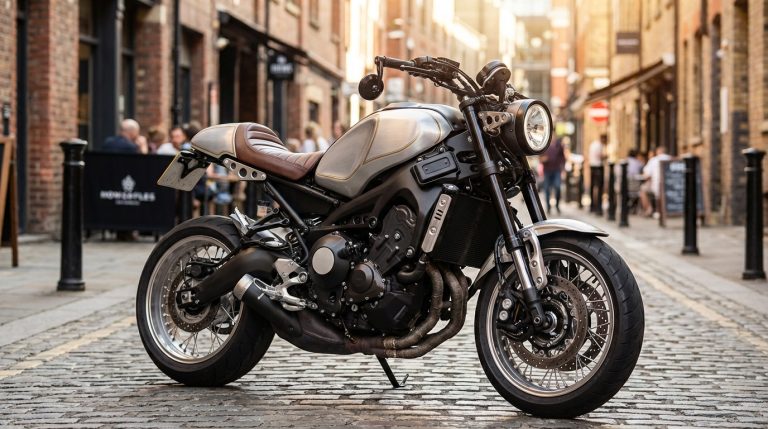
Yamaha FZ750: Iconic Sport Bike

The Yamaha FZ750 stands as a true legend in the world of 1980s sport bikes. Released in 1985, this machine made its mark on its era with its technical audacity, blending power, innovation, and quintessential 80s style. With a four-cylinder, four-stroke engine featuring a 20-valve cylinder head, this motorcycle surprised with its cutting-edge mechanics, while cultivating an elegant yet understated design, far removed from the extravagances often seen in the sport bike category. Despite only moderate success in the face of formidable competition, it carved out a special place in the hearts of motorcycle enthusiasts, both for its performance on the road and its exploits in competition.
A cornerstone of both Yamaha’s history and that of sport bikes in general, the FZ750 paved the way for several innovations that would later be found on legendary models like the YZF750 and the YZF-R1. Its influence extends far beyond its generation: today, it is a sought-after collector’s item, a symbol of an era when technology served performance in perfect balance. Between raw power and mechanical mastery, its legacy continues to inspire classic sport bike enthusiasts and discerning experts who can read an entire era into its lines.
A revolutionary mechanism at the heart of the Yamaha FZ750
The Yamaha FZ750’s engine truly stood out in the 1980s motorcycle landscape. Equipped with a liquid-cooled, inline four-cylinder engine, this 749cc sport bike featured a major innovation: a cylinder head with five valves per cylinder, for a total of 20 valves. This technology generated optimal airflow, allowing for more complete combustion and improving both power and responsiveness. With power peaking around 100 horsepower at 10,500 rpm and a substantial torque of 78.5 Nm, the motorcycle was already positioned as a concentration of performance in its category.
This technical arrangement allows for explosive acceleration and a wider power band, offering the rider linear power delivery and a rapid throttle response. Furthermore, the vertical position of the carburetors improves fuel injection precision, further enhancing the engine’s sporty and responsive character. The 45° inclined cylinder block also contributes to lowering the center of gravity, improving handling and road holding.
One of its most interesting features is the reinforced five-bearing crankshaft, ensuring robustness and reliability, even at high speeds. This technical detail allowed the motorcycle to distinguish itself in long endurance races, notably the 24 Hours of Le Mans motorcycle race, where it proved its resilience in extreme conditions. This innovative engine would later serve as the basis for future engines in the Yamaha range, including the legendary YZF-R1, which draws on this technology to reach new heights in performance.
The technical specifications of the Yamaha FZ750 reflect a skillful blend of pure power and refined execution, thus continuing the tradition of mechanical excellence that has always characterized Yamaha. Its engine, while a technological marvel for its time, remains a model of understated efficiency, devoid of unnecessary extravagance, and boasts a performance profile still admired today.
Design and ergonomics: an iconic yet understated style
The Yamaha FZ750 avoids stylistic excesses, asserting itself with a restrained and functional elegance. Unlike rivals such as the Suzuki GSX-R 750, which made a statement with an aggressive, heavily faired look, the FZ750 opts for a more classic design, where every element seems designed to serve performance rather than flashy aesthetics. This restraint sometimes leads to criticism that it is “too tame,” yet it remains emblematic of the Eighties style, both in its angular lines and its balanced proportions.
The traditional Yamaha tubular steel double-cradle frame combines strength and lightness, providing a solid foundation for the motorcycle. The 39 mm telescopic fork at the front and the rear monoshock make up a well-tuned suspension, promoting both high-speed stability and cornering agility. With a 16-inch front wheel, a popular choice in the 1980s, handling is enhanced to meet the demands of sport riders.
Ergonomically, the riding position strikes a perfect balance between sportiness and comfort for extended use. The relatively high seat provides good visibility, while the intuitively placed controls encourage a sporty feel without tiring the rider. The 22-liter fuel tank allows for long journeys without having to worry about running out of fuel.
The bodywork presents a clean silhouette, where the rear cowl sweeps back in an aerodynamic style without being excessive. The twin headlights at the front, the often-chosen vibrant colors, and the decorative stripes emphasize this vintage character, reinforcing the image of a motorcycle that remains both practical and emblematic of its era. Today, this design is highly sought after by collectors who see the FZ750 as a unique piece, combining mechanical performance with retro aesthetics.
Faced with newer, ultramodern-looking models, the Yamaha FZ750 retains all its appeal thanks to its rare combination of tradition and innovation in design, securing it a unique place among classic sport bikes. For the enthusiast who wants to combine vigorous performance and timeless charm, this balance between aesthetics and function is a real asset.
A story of competition that forges a sporting legend
Beyond its aesthetics and technical specifications, the Yamaha FZ750 also distinguished itself on the track, participating in several prestigious competitions. From its release in the mid-1980s, the FZ750 was put to the test on demanding circuits, notably at the 24 Hours of Le Mans motorcycle race and the Suzuka 8 Hours, two iconic endurance races. These events highlighted the robustness and reliability of its engine, as well as the stability of its chassis, often severely tested in this type of long-distance competition.
Despite fierce competition, particularly from models like the Suzuki GSX-R 750 which dominated with their raw power and aggressive looks, the FZ750 managed to hold its own thanks to its remarkable consistency in delivering performance. Its OW01 racing version, in particular, played a significant role in paving the way for Yamaha’s future superbike models, serving as a technical laboratory and source of inspiration for the YZF range. This sporty machine thus marked the transition from classic racing motorcycles to the arrival of modern superbikes, combining technology and efficiency.
This presence in competition also helped to establish the model’s credibility among enthusiasts and make it a symbol of accessible performance. The FZ750 proved that a a production sports car could excel on the trackpromoting a Yamaha philosophy that remains highly relevant in 2026: the pursuit of the perfect balance between power, handling, and endurance. Its competitive involvement has enriched its legend while setting standards that still influence the development of contemporary sport motorcycles.
It’s interesting to note that the FZ750’s technical and sporting renown has transcended its era: it remains a benchmark in collector circles, where it is often sought after for its glorious yet discreet history, far removed from the commercial hype of modern sport bikes. This heritage makes the Yamaha FZ750 a timeless icon, central to the history of sport motorcycling.
Performance and key figures of the Yamaha FZ750: a concentration of controlled power
Given its technical specifications, the Yamaha FZ750 offers a riding experience characterized by a rare combination of raw power and control. Here is a summary table of the main features that explain its success and longevity:
| Characteristic | Detail |
|---|---|
| Engine type | 4-cylinder in-line, 4-stroke, liquid-cooled |
| Maximum power | 100 hp at 10,500 rpm |
| Displacement | 749 cm³ |
| Couple | 78.5 Nm |
| Frame type | Double tubular steel cradle |
| Front suspension | Telescopic fork Ø39 mm |
| Rear suspension | Monoshock |
| Tires | Front 120/80-16; Rear 130/80-18 |
| Braking | 2 discs Ø 270 mm at the front, 1 disc Ø 270 mm at the rear |
| Weight fully fueled | 209 kg |
| Maximum speed | 240 km/h |
| Tank capacity | 22 liters |
This data illustrates a motorcycle designed for the pleasure of riding, where the power is perfectly controlled to offer balanced performance. Its top speed of 240 km/h testifies to its ability to compete in the sports bike arena, making it a two-wheeler that remains relevant, even compared to modern models that may seem heavier or more technologically advanced.
Among its major strengths, the well-tuned suspension is particularly noteworthy, guaranteeing both comfort and precision in corners, as is the powerful braking system, a key element for ensuring safety at high speeds. The Yamaha FZ750 remains a remarkable sport bike that has stood the test of time while retaining its inherent qualities.
- Advanced 5-valve-per-cylinder engine technology
- Perfect balance between power, flexibility and torque
- Proven and reliable chassis
- Suspension adapted for dynamic driving
- High-performance and safe braking
- Compact design and optimal maneuverability
- Reliability of a robust 5-bearing crankshaft engine
- Timeless design and rarity on the market for collectors
The legacy of the Yamaha FZ750 in the face of modern competition and its evolution in the motorcycle world
As 2026 motorcycles incorporate connected technologies and hybrid powertrains, the Yamaha FZ750 remains an iconic sportbike capable of appealing to both collectors and thrill-seekers. Its technical legacy has significantly influenced subsequent generations at Yamaha, such as the YZF-R1, whose engine is based on the same spirit of mechanical innovation as the FZ750.
In a world where motorcycling is becoming increasingly technical, this 1980s sport bike evokes the beauty of straightforward, unfussy mechanics: a five-valve engine designed for pure performance, paired with a simple yet effective chassis. This return to basics particularly appeals to those who, today, seek an authentic riding experience, far removed from the numerous electronic aids found on modern motorcycles.
With rising prices in the vintage motorcycle market, the FZ750 is seeing its value increase, while remaining affordable for a model of this rarity. This makes it an attractive option for any collector or enthusiast looking to acquire an iconic sport bike suitable for both road and track. This dynamic is evident in the overall evolution of the Yamaha brand, which continues to combine heritage and modernity, as seen in new models such as the YZF-R1 or even innovative three-wheeled concepts like the Niken.
Motorcycle enthusiasts will find in the FZ750 an ideal model to reconnect with the thrill of motorcycling, within a frame that is both stable and high-performing. Its design, its cutting-edge mechanics (at their peak for the time), and its racing history make it a true symbol of the evolution of the sport bike since the 1980s. The FZ750 therefore remains a key milestone in Yamaha’s grand adventure, as recounted in the detailed historical panorama of the brand.
With its charm and efficiency, the Yamaha FZ750 invites us to rediscover a golden age of two-wheelers where every turn and every acceleration had a unique flavor, that of an era when mechanics reigned supreme.
What is special about the Yamaha FZ750 engine?
The FZ750 has an inline four-cylinder engine with a 5-valve cylinder head per cylinder (20 valves in total), offering high power and very responsive acceleration.
What is the maximum speed the Yamaha FZ750 can reach?
This sports bike can reach a top speed of around 240 km/h, which is still impressive for a motorcycle of its generation.
Why is the Yamaha FZ750 considered a legendary motorcycle?
It is recognized for its innovative engine, its solid performance on road and track, as well as its notable participation in competition, particularly in the 24 Hours of Le Mans motorcycle race.
How does the FZ750 influence recent Yamaha models?
The FZ750’s engine and technology served as the foundation for future Yamaha engines, especially for the YZF-R1, with which it shares the spirit of technical innovation.
Is the Yamaha FZ750 still affordable today?
Yes, despite its status as a collector’s motorcycle, its market remains relatively affordable, although prices are rising with the growing interest in retro sports bikes.