Yamaha XT500: Legendary Trail Bike
In the world of off-road motorcycles, few models have managed to transcend the decades with such an aura as the Yamaha XT500. Appearing in the mid-1970s, this motorcycle revolutionized the concept of the trail bike by incorporating a powerful and reliable 500cc four-stroke single-cylinder engine, meeting the demands of a new generation eager for escape and adventure. Highly acclaimed by off-road enthusiasts, it has established itself as an iconic figure, celebrated as much for its robustness as for its unique character.
The Yamaha XT500 embodies the spirit of the legendary adventure bike: mechanical simplicity, exceptional reliability, impressive handling, and an engine character that delivers an unparalleled sensory experience. Its versatility makes it equally at home on rugged trails and paved roads, making it the ideal companion for those new to adventure riding through wild landscapes. Its success stems not only from its technical performance but also from a riding philosophy that values pure enjoyment and unadulterated freedom.
Yamaha XT500: the genesis of a legendary trail bike in the heart of the 70s
While the 1970s were dominated by the relentless pursuit of speed and large engine displacements, Yamaha took a bold gamble by offering a motorcycle that prioritized simplicity and reliability. The XT500 was born in a context where the leisure culture championed escape, wide-open spaces, and new forms of mobility. In America, the trail bike was gradually establishing itself as an alternative to classic scramblers, encouraging off-road excursions and adding a sporting dimension with off-road events like the famous Baja.
Faced with new constraints, particularly the first American anti-pollution regulations, Yamaha innovated by reviving a compact yet robust four-stroke single-cylinder engine. Product Planning imposed strict specifications for a reliable, easy-to-maintain engine, and above all, one capable of tackling all types of terrain. The technical challenge was significant: finding the right balance between performance and durability, while offering a lightweight machine with optimized ground clearance to handle rough trails.
Engineer Shiro Nakamura and his team, despite a difficult development phase lasting several years, succeeded in designing a high-performance engine with a bore and stroke of 87 x 84 mm, offering particularly impressive torque, ideally suited to off-road riding. They opted for a CAM system mounted on bearings, a compact crankshaft with a needle bearing connecting rod, and dry sump lubrication integrating the oil into the frame—a key innovation for reducing engine height and improving handling.
These technical choices marked a real turning point for trail riding. The Yamaha XT500, presented as a preview in Los Angeles in 1975 and then at the Tokyo Motor Show the same year, immediately established its status as a complete motorcycle, capable of accompanying the most demanding riders on their adventures far from the beaten track.
Technical specifications and design of the Yamaha XT500: simple and effective
The Yamaha XT500’s success undoubtedly lies in its intelligent mechanics and clean design. This classic motorcycle stands out for the purity of its lines and the robustness of its 500cc single-cylinder four-stroke engine, delivering approximately 32 horsepower. This generous engine, combined with a five-speed gearbox and a progressive clutch, offers remarkable riding flexibility both in the city and on rough trails.
The lightweight and rigid steel tube frame ensures excellent handling, further enhanced by a total weight of less than 140 kg, resulting in surprising agility even on technical sections. The choice of a telescopic front fork and a swingarm at the rear guarantees a good compromise between comfort and performance. However, the drum brakes, while typical of the era, require some caution as they lack bite in a modern context.
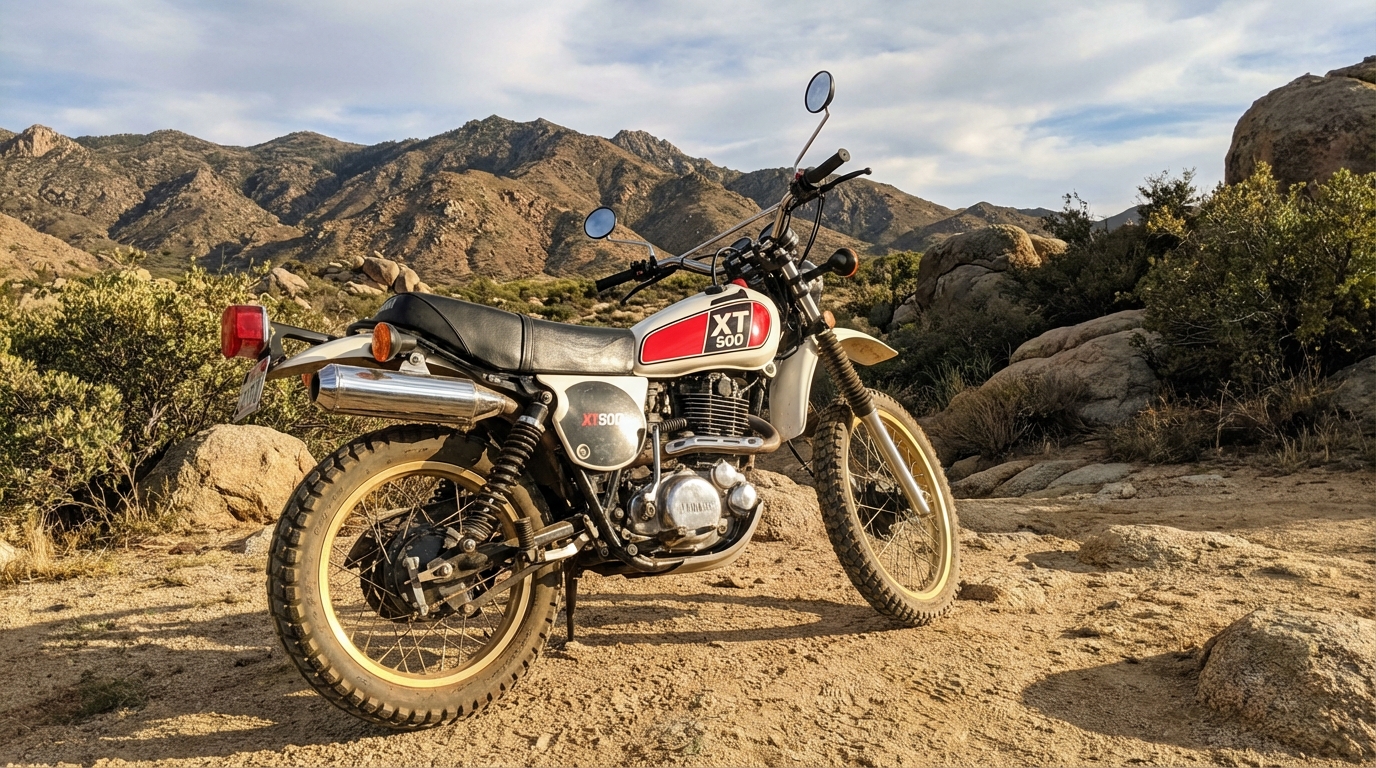
Aesthetically, the XT500 features an angular fuel tank, often finished in off-white or aluminum with contrasting red lettering. Its wide handlebars, low, comfortable seat, and high fenders all attest to its off-road capabilities. The motorcycle is easily recognizable by its iconic chrome kickstarter, which perfectly embodies its character and demanding starting requirements.
| Characteristic | Detail |
|---|---|
| Engine | Single-cylinder, 4-stroke, 499cc, air-cooled |
| Power | 32 horsepower at 6500 rpm |
| Gearbox | 5 reports |
| Weight | Approximately 140 kg |
| Braking | Front and rear drums |
| Pendant lights | Front telescopic fork, rear swingarm |
| Suspension travel | Moderate, stable on varied terrain |
| Startup | Kick, with manual decompression |
This mechanical simplicity makes maintenance easy, a considerable advantage for anyone venturing far from the cities. The XT500 represents the very essence of the classic motorcycle, where every element contributes to harmonious and accessible operation, without superfluous electronics or unnecessary complexity.
The driving experience: an all-terrain trail bike with an inimitable character
The Yamaha XT500 offers a unique experience, where the connection between rider and machine truly comes to life. It’s not the numbers that make the legend, but rather the deep sound and characteristic vibrations of the 500cc single-cylinder engine, which immediately convey a sense of raw, controlled power. The kick-start, often a source of apprehension, is now an integral part of the model’s identity. Mastering this ritual demands respect and patience, strengthening the bond between rider and machine.
On the road, the XT500 transforms into a faithful companion that delivers genuine riding pleasure. Its generous torque allows for smooth, responsive acceleration. Its low weight and slim profile facilitate maneuvering and low-speed navigation, an essential factor off-road, especially during a novice rider’s first adventures on a trail bike, when they are discovering the thrill of off-road riding.
Admittedly, braking requires a degree of caution given the technology of the time, but this constraint is merely a minor detail in the overall philosophy of the motorcycle. The suspension effectively absorbs imperfections, and the stable ride encourages a smooth and relaxed riding experience. The XT doesn’t aim to impose speed, but rather to stimulate adventure, exploration, and that unfiltered feeling of adrenaline and serenity.
This motorcycle is a true bridge between past and present, between the authenticity of off-road riding and the modern aspiration for escape. At every turn, every climb, it invites you to reconnect with the essence of trail riding, where the mechanics remain simple, and where every twist of the throttle translates into palpable emotion.
Yamaha XT500 and adventure: the benchmark for rally raids and extreme explorations
Beyond its technical qualities and its strong character, the Yamaha XT500 has distinguished itself on the toughest terrains and in the most prestigious events, notably in the Paris-Dakar of the 70s and 80s. This machine has been chosen by many adventure riders for its robustness and its ability to cover kilometers in the extreme conditions of the desert and rough tracks.
The list of its achievements is impressive: from Cyril Neveu’s victory in the 1979 and 1980 Paris-Dakar rallies to its widespread presence in African rally fields, the XT500 has cemented its legendary status as an enduro and trail icon. Of the 33 motorcycles that arrived in Dakar in 1982, more than 12 were Yamaha XTs, proof of its proven effectiveness and unwavering reliability.
- Success at the Abidjan-Nice Rally in 1977: 14 models at the start, 10 at the finish.
- Victory of Cyril Neveu in the Paris-Dakar 1979 and 1980.
- Many drivers ranked in the top 10 during these crucial years of rally-raid.
- Widespread adoption in extreme expeditions thanks to its simple 500cc engine and lightweight chassis.
These performances not only boosted Yamaha’s image within the off-road community, but they also inspired a generation of motorcyclists to see motorcycling as a vehicle for freedom and self-improvement. The XT500 thus became the ultimate dream machine for adventurers seeking their next challenge.
Versions, heritage and cultural impact: the Yamaha XT500 on the big screen and in everyday life
Over the decades, the Yamaha XT500 has undergone several evolutions while retaining its essence. As early as 1976, the American version appeared with some modifications for homologation, followed by a notable redesign in 1977, which raised the ground clearance thanks to an exhaust placed in the middle of the motorcycle — a distinctive feature still recognizable today.
The 1980s brought technical improvements, notably a higher-performance fork, an optimized engine, and the gradual adoption of 12 volts in 1986 for improved lighting. In 1988, the limited-edition XT500SP offered a remarkable finish with chrome parts and premium details.
In terms of popular culture, the XT500 has made its mark in cinema, notably in the famous James Bond film “For Your Eyes Only,” where a memorable chase scene features an XT500 equipped with studded tires on snow. This iconic scene perfectly illustrates the spirit of adventure and robustness embodied by the machine.
The impact of the XT500 extends far beyond mere sporting or technical aspects. Today, it is a true icon, still revered by classic motorcycle enthusiasts, a symbol of a lifestyle blending freedom, adventure, and simple mechanical pleasure. The reissue announced for 2026 testifies to this living legacy and the continued strong demand for the adventure segment that it helped popularize.
- Different versions adapted to regulations and field needs between 1976 and 1990.
- A prominent presence in motorcycle culture and international pop culture.
- Direct influence on the design of modern trail bikes and the Yamaha spirit of adventure.
- Gradual modernization while retaining the iconic single-cylinder engine.
A first adventure ride on a Yamaha XT500 is also about reconnecting with a chapter of history where every journey is an adventure. Riding this legendary motorcycle means taking part in an experience enriched by its glorious past and futuristic simplicity.
What is special about the Yamaha XT500 engine?
The XT500 is equipped with a 499cc single-cylinder 4-stroke engine, renowned for its generous torque, reliability and mechanical simplicity suitable for off-road use.
Why is the Yamaha XT500 considered a legendary trail bike?
It embodies the perfect combination of robustness, maneuverability and engine character, and has established itself through its victories in rally-raids and its cultural heritage.
Is it difficult to start a Yamaha XT500?
Kick-starting requires a specific technique and patience, but once mastered, it is an integral part of the charm and authentic character of the motorcycle.
What improvements were made to later versions of the XT500?
The changes mainly concern the suspension, braking, the switch to a 12-volt electrical system and engine adaptations, while retaining the original soul of the trail bike.
Is the Yamaha XT500 still suitable for trail riding today?
Yes, thanks to its reliability, lightness and engine character, it remains a preferred choice for classic motorcycle and off-road adventure enthusiasts.