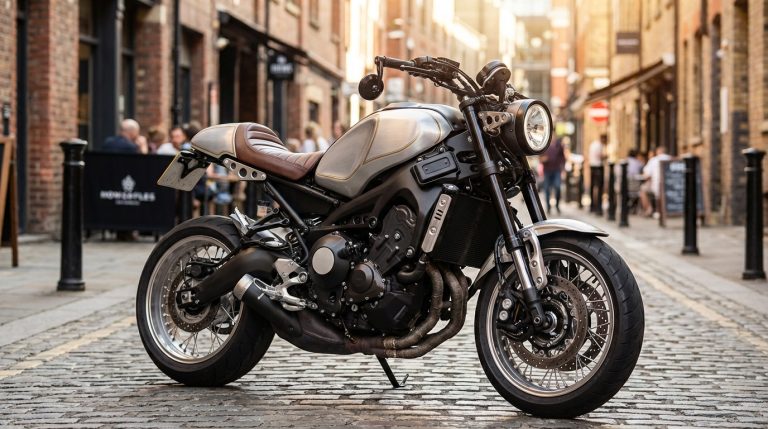
Yamaha V-Max: Legendary Muscle Bike

Since its creation in 1985, the Yamaha V-Max has established itself as the epitome of pure power on two wheels. With its explosive V4 engine and aggressive design, this Japanese muscle bike has captivated performance enthusiasts and motorcycle culture across generations. More than just a speed machine, the V-Max is a true legend, embodying the spirit of the American dragster adapted to Japanese tradition. In 2009, its rebirth with the 1700 model took power to a new peak, confirming its place among the essential icons of the contemporary motorcycling world. This extraordinary journey blends raw aesthetics, cutting-edge technology, and intense sensations, making the Yamaha V-Max a myth that will continue to resonate in 2026.
Today’s focus: understanding how this legendary motorcycle revolutionized its segment, the innovations that propelled it to the top, and why it continues to inspire such enthusiasm. From its origins to its modern maintenance, every detail reveals a passion for exceptional mechanics, as well as a motorcycling culture rooted in power and customization. Let’s explore together the secrets and world of this muscle bike that continues to inspire riders worldwide.
Birth of a monster: the origin of the Yamaha V-Max and its historical impact
When Yamaha unveiled the V-Max in 1985, the motorcycle immediately stood out for its radical design and technical audacity. Unlike traditional Japanese roadsters and sport bikes, this muscle bike offered a true aesthetic and mechanical departure. Its 1198cc V4 engine produced around 145 horsepower, a remarkable feat at the time, and, most importantly, it benefited from the innovative “V-Boost” system. This mechanical device opened additional throttle valves in the carburetors at high engine speeds, injecting extra air and providing impressive, almost explosive acceleration. The result: a motorcycle perfectly suited for starting from a standstill, capable of instant acceleration and lightning-fast power delivery.
The squat lines and aggressive look, with its polished aluminum faux air intakes, left no doubt about its intentions. The solid steel frame and shaft drive displayed remarkable strength, but also considerable weight, which reinforced its muscular appearance. The V-Max thus embodied a raw approach, running counter to lighter, more technical trends. This legendary motorcycle encouraged enthusiasts to rediscover intense pleasure, embodying uncompromising power.
Its influence extends far beyond performance. It also transformed motorcycle culture by establishing the muscle bike category, which was previously underrepresented in the Japanese market. This hybrid of the American dragster and Japanese precision created a new ideal, blending aggressive aesthetics with powerful engineering. The launch of the V-Max thus opened an iconic chapter in the history of Yamaha and, more broadly, of sport motorcycles.
At a time when motorcycle culture is shifting towards increasingly technological and eco-friendly models, the V-Max’s prescience remains undiminished. It embodies an era where perfect performance took precedence over lightness or digital gadgets, an era that still thrills those seeking to experience the raw power of mechanical exhilaration. The story of this motorcycle is a manifesto for raw power, an invitation to relive an era where every turn could unleash an explosion of pure adrenaline.
The Yamaha V-Max 1700: evolution and modernization of a legendary muscle bike
Over the years, the V-Max has maintained its status as an iconic motorcycle. However, the passage of time and technological advancements necessitated a major redesign. In 2009, Yamaha introduced the V-Max 1700, a machine that respects its heritage while propelling it into a new era of extreme performance. This version, equipped with a redesigned 1679cc V4 engine, develops up to 200 horsepower in its unrestricted version, placing it firmly among the most powerful muscle bikes ever produced.
This explosion of power is contained within a modern, thinner, and lighter aluminum frame that offers improved weight distribution and optimal rigidity. The design is also significantly more refined, combining aggression and fluidity to create an even more impressive and intimidating silhouette. The V-Max 1700’s look exudes unwavering confidence, reinforced by aerodynamic details and high-quality finishes.
However, Yamaha hasn’t abandoned the fundamentals: the combat riding position, the muscular lines, and the famous digital V-Boost for more precise rider response. The modern fuel injection system replaces carburetors, ensuring better fuel efficiency while maintaining the raw acceleration. These technical choices demonstrate a skillful balance between tradition and innovation, where the muscle bike reaches a level of technical maturity suited to the demanding riding of the 2020s.
In addition to the engine, the onboard electronics offer a multitude of now-essential rider aids: traction control, adjustable power modes, integral ABS, and an improved transmission. These advancements in no way detract from the V-Max’s wild character; on the contrary, they make it more accessible to riders eager to enjoy the torque without sacrificing safety.
This technical evolution positions the Yamaha V-Max 1700 not only as a renewed legend, but also as an essential benchmark against its competitors in the muscle bike segment, including the remarkable Moto Guzzi Audace 1400By combining technical rigor, immense power and spectacular design, the V-Max perpetuates its reign at the top of the contemporary motorcycle world.
The mechanics and technology behind the exceptional power of the V4 engine
The beating heart of every Yamaha V-Max is its uniquely designed V4 engine, which gives this muscle bike its incomparable character. The engine’s design is a technical marvel, ensuring impressive power and torque from low revs, delivering blistering acceleration, ideal for explosive starts on the track or in the city. The V4, initially at 70° and later at 65° depending on the generation, produces a deep, throaty sound that is instantly recognizable, almost like an acoustic signature.
The secret to the V4 engine’s character lies in its architecture and the V-Boost system. This system, still present on the 1700 in a modernized form, opens secondary throttle valves to the cylinders at high engine speeds, maximizing air intake and optimizing combustion. This process gives the motorcycle a real boost, delivering a burst of power from around 5,750 rpm, a rare sensation on a production motorcycle. This technology established the V-Max as the ultimate muscle bike, with no compromise between power and control.
The engine’s robustness is also ensured with particular attention to reliability, despite extreme stress. The valve train and cooling system are meticulously designed to withstand intensive use. The lightweight alloy engine block helps to reduce weight, although it remains substantial, essential for maintaining rigidity and handling at high speeds.
The evolution of the engine from the 1200 to the 1700 is accompanied by a modernization of the fuel system: conventional carburetion gives way to fuel injection, allowing for better emissions control and a more immediate throttle response. The 1700 version thus gains in smoothness, but without ever sacrificing its characteristic raw power. Yamaha’s engineering demonstrates a rare expertise in balancing pure power and thermal management, the keys to an unforgettable riding experience.
This V4 engine continues to fuel the passion of enthusiasts and customizers, who constantly seek innovations to further exploit its immense potential. Customization around the V4 engine remains a dynamic sector where enhanced performance blends with aggressive aesthetics, a characteristic inherent to the motorcycle culture surrounding this legend.
Maintaining and personalizing your Yamaha V-Max: keys to preserving the legend
Owning a Yamaha V-Max, whether the 1200 or 1700 version, is more than just a purchase. It’s a passionate commitment to a demanding machine that requires precise and regular maintenance. The longevity and reliability of this muscle bike depend largely on the care given to its mechanical and electronic systems. Among the critical components to monitor, the V-Boost system is paramount. It must be checked, cleaned, and synchronized regularly to preserve its extraordinary acceleration and engine response.
Carburetion on older models requires thorough cleaning and meticulous adjustment to prevent power loss. The more modern 1700 version benefits from a less temperamental fuel injection system but still requires regular checks of the sensors and intake system to prevent any performance degradation. Braking, particularly on the 1200 model, should be upgraded to ensure safety with reinforced components; many riders opt for braided brake lines or high-performance brake pads to compensate for the power without any issues.
Suspension is another major concern on this muscle bike. The considerable weight necessitates suitable shock absorbers and springs, often replaced by progressive and stiffer versions to control the motorcycle’s reactions, especially during violent acceleration or in tight corners.
The shaft drive also requires regular attention, with proper lubrication and precise tension adjustment to prevent clunking or torque loss. Those who enjoy customization will find this simple yet robust mechanism an ideal base for modification. It’s common to integrate aesthetic upgrades, special air filters, higher-performance exhausts, and optimized engine settings to push the limits of raw performance even further.
Among enthusiasts, the motorcycle culture surrounding the V-Max also fosters technical exchanges and gatherings, both for restoration and performance. Certain dealerships and specialized workshops, such as those located near Lille, offer a high-quality service dedicated to the maintenance and preparation of Yamaha V-Max motorcycles, restoring each model to its original vigor while ensuring its technical evolution.
- Regular checks and cleaning of the V-Boost system
- Carburetor maintenance or injection control depending on the model
- Braking system improvements (hoses, pads)
- Suspension reinforcement with progressive springs
- Cardan shaft transmission maintenance and appropriate lubrication
Price, accessibility and motorcycle culture surrounding the Yamaha V-Max in 2026
Despite its legendary status, it’s still possible to buy a Yamaha V-Max in 2026. The allure of this iconic muscle bike remains strong, but it comes with specific economic realities. The 1200 version can be found at relatively affordable prices, generally between €4,000 and €8,000, depending on its condition and mileage. These vintage machines require particular attention to the aforementioned mechanical aspects to ensure optimal reliability.
In contrast, the newer version, the V-Max 1700, requires a more substantial investment, ranging from €12,000 to €20,000. This budget reflects the increased technological complexity and superior performance level. This market is primarily aimed at enthusiasts who can meticulously maintain their motorcycle and who wish to own a true modern collector’s item.
The motorcycle culture surrounding the V-Max in 2026 is particularly vibrant. Dedicated clubs and forums bring owners together to share advice, experiences, and customization tips. The machine’s greatest strength remains its strong identity: a “eye-catcher” with a unique style, a performance marvel intrinsically linked to the muscle bike concept.
This recognition has even transcended national borders, influencing the international scene and inspiring competing models such as the Guzzi Audace 1400 Muscle BikeFor many, the V-Max remains the absolute benchmark, a living artifact that transcends the simple motorcycle to become an emblem of power and timeless style.
Finally, regarding insurance and licensing, the Yamaha V-Max requires an A license due to its high performance. While its insurance cost is higher than that of conventional motorcycles, it remains affordable for experienced riders who are skilled in handling their machine. Its fuel consumption, estimated at between 8 and 12 liters per 100 km, is also an important factor to consider in the rider’s budget.
| Characteristic | V-Max 1200 (1985) | V-Max 1700 (2009) |
|---|---|---|
| Engine | V4 at 70° | V4 at 65° |
| Displacement | 1198 cm³ | 1679 cm³ |
| Power | ~100 hp (145 hp with V-Boost) | 106 hp (200 hp in free version) |
| Couple | ~100 Nm | ~140 Nm (167 Nm in the unrestricted version) |
| Weight | ~280 kg | ~310 kg |
| Transmission | Gimbal | Gimbal |
| Frame | Steel | Diamond-type aluminum |
| Average market price (2026) | €4,000 – €8,000 | €12,000 – €20,000 |