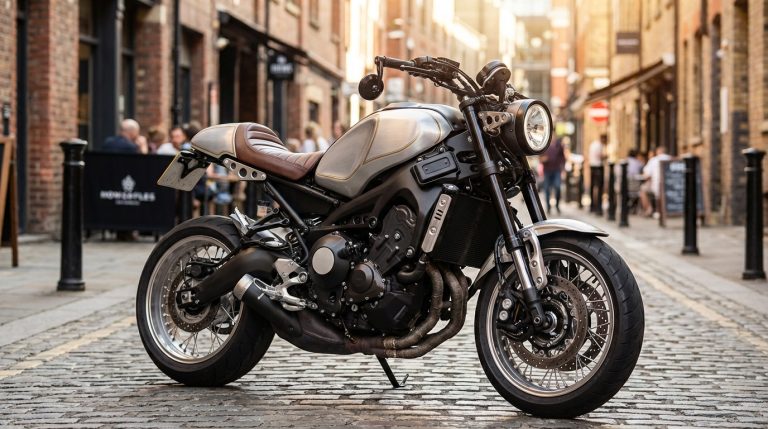
Yamaha R-Series: Cutting-Edge Technologies

At the crossroads of performance and innovation, the Yamaha R-Series sets a new benchmark for modern sport bikes. With their sharp design and unprecedented technological arsenal, these machines embody the very essence of the accessible and refined sport motorcycle. The recent power boost of the 2026 Yamaha R7 perfectly illustrates this dynamic, with surprising technical advancements that revolutionize its handling without sacrificing its authenticity or ease of use. Above all, it is the integrated cutting-edge technologies – from an advanced electronic system to a perfectly calibrated, high-performance engine – that place this range at the heart of the contemporary motorcycling world.
Faced with increasingly fierce competition, Yamaha is responding with a measured strategy, capitalizing on its unified CP2 platform already adopted for the MT-07, Tracer 7, and Ténéré 700. This intelligent technical choice promotes a consistent product range while guaranteeing competitive prices and performance that meets expectations. Versatility, ergonomics, and active safety become priorities to appeal to a demanding clientele seeking controlled power and a bold, sporty design. The introduction of customizable riding modes, traction control, and advanced suspension transforms the Yamaha experience, combining riding pleasure with technical mastery.
Yamaha R7 2026: A technological evolution that shakes up the R-Series formula
The 2026 Yamaha R7 represents a subtle yet profound revolution within the R-Series. Contrary to expectations focused on larger models like a hypothetical R9 or a major redesign of the R1, it’s the mid-displacement sportbike that receives a significant technical refresh. This update goes beyond a simple cosmetic facelift and embraces a decidedly modern philosophy, based on sophisticated yet intuitive electronics.
The switch from a mechanical throttle cable to a YCC-T ride-by-wire system marks a true turning point. This technology, borrowed from models like the MT-07, unlocks precise engine management through riding modes. Five distinct modes allow for rapid adaptation to road or track conditions, modulating responsiveness and power according to the rider’s preferences. For example, a more subdued road mode prioritizes smoothness and fuel efficiency, while a sport mode intensifies engine response and delivers a more exhilarating experience. This intelligent feature is also complemented by switchable traction control, a feature long absent from this segment but now essential for ensuring maximum safety in all circumstances.
In short, this technical evolution brings the R7 in line with its rivals in terms of electronic rider aids, while retaining its simplicity and lightness, emblematic characteristics of the R-Series. It’s worth remembering that this model, by its very nature, is aimed at riders seeking to combine riding pleasure and reliability without excessive complexity. The 2026 R7 thus succeeds in combining innovation and accessibility, a balance rarely achieved in the Supersport category.
A high-performance engine that meets Euro 5+ standards: combining power and environmental responsibility
The 2026 Yamaha R7 retains the mechanical heart that made it a success: the 689cc CP2 twin-cylinder engine, delivering consistent power. 72.4 horsepower and a generous couple of 50.2 lb-ftThis engine, renowned for its flexibility and responsiveness, continues to deliver dynamic riding both on the road and the track. The engine’s wide operating range offers undeniable versatility, allowing the motorcycle to be adapted to different rider profiles and uses, thus enhancing its appeal in the segment.
This 2026 version is distinguished in particular by its compliance with the Euro 5+ standard, an essential step in the face of evolving environmental regulations. The technical modifications have primarily focused on the exhaust system and the catalytic converter, which is now more efficient, without compromising the legendary sound or the engine’s inherent character. Admittedly, the motorcycle gains a kilogram (189 kg fully fueled), but this in no way detracts from its feeling of lightness or its exemplary handling.
Maintaining a high-performance engine while respecting environmental requirements illustrates Yamaha’s ability to innovate without compromising its commitment to accessible and exciting machines. To learn more about the Yamaha families, you can consult resources on the 2026 range, which details all the models and their technological developments.
Sporty design and advanced suspension: the perfect balance between aesthetics and performance
The design of the 2026 Yamaha R7 embodies the sporty spirit of the R-Series, with a redesigned aerodynamic profile that combines visual aggression with optimized functionality. Sharp lines, the harmonious integration of aerodynamic elements, and minimal weight contribute to a feeling of control and speed at first glance. Thanks to this new look, the motorcycle asserts itself as a track beast ready to roar, while maintaining a refined and approachable appearance.
Furthermore, the advanced suspension plays a key role in the machine’s dynamic behavior. The chassis, already renowned for its robustness and agility, has been further refined to offer increased responsiveness and improved damping on varied terrain. This suspension enhances rider confidence both in fast corners and on bumpy roads. Yamaha engineers have thus succeeded in maintaining a delicate balance between comfort and performance, appealing to both novices and experienced riders.
This technical alliance between sporty design and optimized suspension contributes significantly to the excellent riding experience. The machine responds instantly to inputs with surgical precision, allowing the rider to fully exploit its power without sacrificing safety. This philosophy is also found in other models from the brand featuring advanced technologies such as the Tracer 900 Sport Touringwhich also combines performance, comfort and innovation.
Modern electronic system: traction control and driving modes for a customized experience
The switch to a fully electronic system marks a major step forward for the 2026 R7. The YCC-T ride-by-wire system, now integrated, is not limited to simple throttle control but opens the door to a multitude of features focused on safety and ride personalization.
Traction control, adjustable to the rider’s preferences, provides an essential layer of safety, particularly on slippery surfaces or during hard acceleration out of corners. By intervening discreetly yet effectively, this system prevents unexpected skidding and maintains a stable trajectory, preserving the inherent sportiness of the Yamaha R-Series.
This versatility is enhanced by the presence of several driving modes, the most commonly used of which are:
- Road Mode prioritizing gentleness and economical management for everyday urban comfort
- Sports Mode : enhancing power and responsiveness for a more dynamic and engaging driving experience
- Rain mode : smoothing the engine response and maximizing stability on wet surfaces
This modularity allows for rapid adaptation to current constraints, making the motorcycle truly versatile. Unlike some high-end sport bikes, the R7 does not have an IMU (Inertial Measurement Unit), a choice made to maintain simple and effective handling.
Product range consistency and positioning against the competition: Yamaha’s strategy for 2026
Yamaha has wisely aligned the 2026 R7 with a common technology platform within the CP2 engines, also used in iconic models such as the MT-07 or the Ténéré 700. This technical homogeneity not only optimizes costs but also reliability, thus facilitating maintenance and customization of the machines for enthusiasts of the brand.
Facing well-established competitors like the Aprilia RS 660 or the Kawasaki Ninja 650, the R7 positions itself as a mid-range sportbike, offering an excellent compromise between accessible power, modern equipment, and reasonable cost. Its philosophy is clear: a motorcycle that embodies pure Yamaha sporting tradition, without falling into technological excess, while adopting appropriate electronics to ensure both safety and enjoyment.
This positioning is also reflected in an expected price of around €9,900, a slight adjustment justified by the onboard improvements that don’t necessarily detract from the overall experience. This consistency in the spirit of the range also contributes to the loyalty of riders looking for a versatile sports bike, equally at home on the road and on the track.
| Characteristic | Yamaha R7 2026 | Aprilia RS 660 | Kawasaki Ninja 650 |
|---|---|---|---|
| Maximum power (hp) | 72.4 | one hundred | sixty-seven |
| Weight when fully fueled (kg) | one hundred eighty-nine | one hundred eighty-three | one hundred ninety-three |
| Driving modes | Yes | Yes | No |
| Traction control | Yes, switchable | Yes | No |
| Approximate price (€) | 9,900 | 13,000 | 8,700 |
For enthusiasts eager to explore the wealth of Yamaha models further, detailed resources are available, particularly on the legendary… YZF R6 Or YZF R1, which define the standards for high-end sports cars and fuel the technical inspiration of the R-Series.
Is the 2026 Yamaha R7 compatible with an A2 license?
No, the R7 retains its power output of over 70 horsepower, making it incompatible with the A2 license. Yamaha does not offer a restricted version of this model.
What are the main differences between the 2026 R7 and the previous generation?
The 2026 version incorporates a ride-by-wire system, customizable riding modes, and traction control. The CP2 engine remains unchanged, retaining its performance.
Does the 2026 Yamaha R7 have an inertial measurement unit (IMU)?
No, the R7 is designed as an accessible and simple sports car, and does not benefit from an IMU unlike more sophisticated competitors.
What is the weight of the 2026 Yamaha R7?
The advertised weight with all tanks full is 189 kg, which is about 1 kg more than the previous version, due to the addition of electronic equipment and Euro5+ standards.
When will the 2026 Yamaha R7 be available?
The official presentation is expected at the EICMA show in Milan in November 2025, with the first deliveries planned for late 2025 or early 2026.