Yamaha History: From 1955 to Today
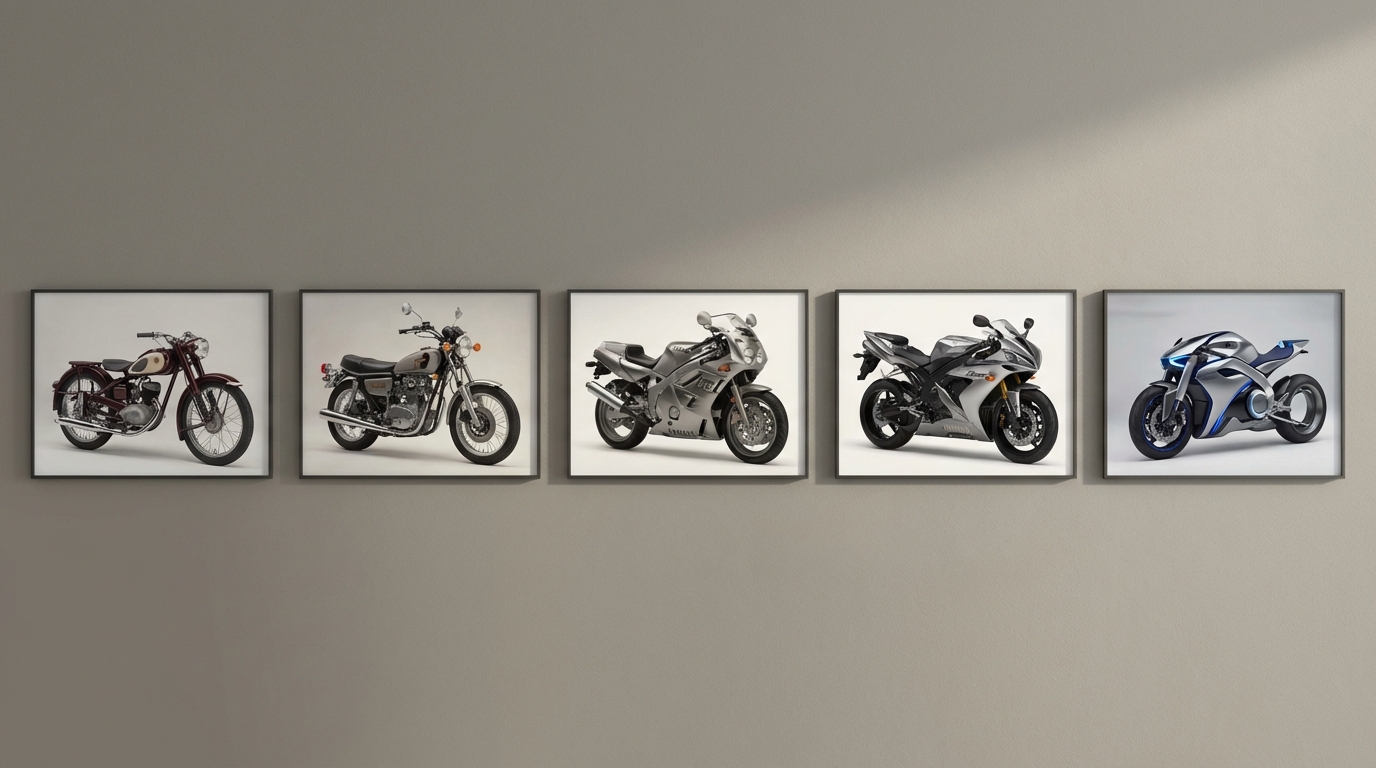
Since its creation in 1955, Yamaha has established itself as an iconic figure in the world of motorcycling. This Japanese brand, initially a company specializing in the manufacture of musical instruments, conquered the motorcycle world through constant evolution, flawless technological innovation, and a perpetual spirit of invention. Yamaha’s history is marked by an impressive journey where passion, quality, and performance combine to define a strong, globally recognized identity. From its legendary models to its exploits on the racetrack, Yamaha today represents an inseparable symbol of contemporary motorcycle culture, perfectly embodying the alliance between tradition and modernity.
As the brand continues to revolutionize the industry in 2026, with innovations that constantly redefine standards, it’s essential to revisit Yamaha’s roots to understand how this company has thrived over the decades. Each stage of its development tells a story of success, ambition, and pushing boundaries, embodied by legendary motorcycles that continue to captivate enthusiasts. Let’s delve into this fascinating saga, from the launch of the first motorcycle to the latest technological advancements that continue to fuel its influence.
The foundations of Yamaha Motor Company and its initial impact on the world of motorcycling
In 1955, Yamaha Motor Co., Ltd. was established, separating from Yamaha Corporation, which had originally been founded in 1887 by Torakusu Yamaha as a musical instrument manufacturer. This separation aimed to seize the immense opportunity offered by the rapidly expanding motorcycle industry in Japan and internationally. At its inception, the company consisted of only 274 determined and passionate employees, ready to transform this new challenge into a major industrial success. The first motorcycle produced, the YA-1, designed with innovation and precision, was a true revolution: a 125cc two-stroke with a refined design and astonishing performance that quickly won over both amateurs and professionals.
This period established Yamaha’s identity as a dynamic and perfectionist manufacturer. At the time, the brand didn’t simply dream of producing motorcycles, but of inventing a new riding experience. This ambition materialized very quickly, thanks in particular to the ability to combine performance-oriented technology with elegant aesthetics. From the 1960s onward, Yamaha began to establish itself in global markets, expanding its range and introducing models marked by a distinctly sporty spirit. This was the beginning of a conquest that would place the brand among the world’s leading manufacturers and solidify its reputation on the racing circuit thanks to prestigious victories.
A key element of this initial success was the international establishment in New York in 1955 with Yamaha Corporation of America, which allowed the brand to quickly reach a Western audience eager for innovation and quality. This global network also provided ideal preparation for Yamaha’s entry into motorcycle racing, where history would continue to be written with great force, giving rise to iconic models still celebrated today. To understand Yamaha’s remarkable trajectory, it is essential to grasp how its early steps influenced its future positioning.
The technological advancement and diversification of the Yamaha brand in the motorcycle industry
Over the decades, Yamaha has consistently pushed the boundaries of technology, incorporating its innovations to refine the design and performance of its motorcycles. From the 1980s onward, the brand demonstrated its ability to introduce major advancements, meeting the demands of competition and the expectations of passionate motorcyclists. Yamaha engineering now combines power, reliability, and handling—a treasure for riders of all skill levels.
Yamaha’s evolution is rooted in a constant trajectory of invention, blending research and development with a pioneering approach. For example, the adoption of new electronic and mechanical technologies has made it possible to reduce the weight of motorcycles while increasing their power and fuel efficiency. Two-stroke engines have been progressively replaced by more powerful and environmentally friendly four-stroke engines, an ecological shift that the brand anticipated by innovating in the field of emissions control technology. Yamaha has also offered improved transmission systems, rivaling the technologies used by other major brands, as you can see in some contemporary models presented on this page dedicated to transmission.
- Development of high energy efficiency engines
- Integration of electronic injection systems
- Constant chassis improvements for better cornering precision
- Harmonizing technology and design to offer attractive models
- Expanding the range with motorcycles suited to all users: sport, trail, roadster
Today, Yamaha continues this legacy of innovation with powerful yet accessible models, incorporating modern technologies such as ABS, traction control, and connected digital interfaces to bring a new dimension to riding. It is this adaptability and perpetual pursuit of excellence that explains why the brand remains a favorite among motorcycle enthusiasts, confirming a deep commitment to the technological transformation of motorcycling.
Yamaha’s iconic models and their place in motorcycle history
Several Yamaha motorcycles have left their mark on two-wheeled history through their design, performance, or role in the evolution of riding techniques. Each embodies a key stage in the brand’s development and in the history of motorcycling worldwide. Among them, the Yamaha RD350, very popular in the 1970s and 1980s, is a perfect example of the perfect blend of power and agility. This two-stroke model quickly became a legend among enthusiasts thanks to its impressive performance for the time.
Another essential model is the Yamaha YZF-R1, introduced in the late 1990s and still a benchmark in the world of sport motorcycles. The R1 symbolizes the successful fusion of power, technology, and aggressive design that Yamaha has maintained and improved to remain an undisputed leader. Fans of the brand recognize in this motorcycle a concentration of Japanese expertise, always at the forefront of competitiveness and reliability, far removed from mere industrial production.
Yamaha motorcycles are not only appreciated for their performance but also for their diversity. Yamaha has distinguished itself in various segments, such as adventure bikes with the famous XT600, touring bikes, and off-road motorcycles. This diversity demonstrates a clear desire to cover all uses and desires, making motorcycling accessible to a wider audience, as seen in several comparisons and tests illustrating this versatility, particularly on websites specializing in reviews and analyses of models released by other brands, for example. comparisons comparing several renowned brands.
| Yamaha model | Launch year | Main feature | Influence in the world of motorcycling |
|---|---|---|---|
| YA-1 | one thousand nine hundred fifty-five | First motorcycle, 125cc two-stroke engine | This marks the beginning of modern Japanese motorcycle production. |
| RD350 | 1970s-1980s | Powerful and maneuverable two-stroke engine | Icon among young enthusiasts for his performance |
| YZF-R1 | one thousand nine hundred ninety-eight | High performance sports motorcycle | A benchmark in sports racing and the sports segment |
| XT600 | one thousand nine hundred eighty | Versatile trail | A benchmark for trail running on roads and paths |
Yamaha and innovation at the heart of its sporting and industrial development
One of Yamaha’s greatest strengths lies in its ability to combine technology and competition. The brand has consistently leveraged its racing experience to develop ever more high-performance motorcycles. From the 1960s onward, Yamaha actively participated in international competitions, winning Grand Prix titles that solidified its global reputation. These sporting achievements have a direct impact on the design and evolution of production models, often resulting from the challenges of the racetrack.
Yamaha’s racing department is also behind key inventions that have changed the very design of modern motorcycles: for example, the early introduction of innovative frame structures, advanced braking systems, and more recently, sophisticated electronic components such as intelligent suspension. These innovations allow riders to optimize their riding while ensuring increased safety, transforming the riding experience on both road and track.
Yamaha’s engineering tradition in motorsport has also resulted in long-standing partnerships with world-renowned riders, who have become brand ambassadors, amplifying its reach and leading image. These collaborations fuel research and ensure that each new model is the culmination of expertise accumulated over decades.
Yamaha’s place in the current motorcycle landscape and its technological future
In 2026, Yamaha remains a key player in the motorcycle world, with a range that reflects unparalleled expertise and a constant commitment to innovation. From urban motorcycles to high-performance track machines, the brand offers a wide selection, combining riding pleasure and reliability. With sustainable development becoming increasingly important in all industries, Yamaha is also investing in the ecological transition by exploring and integrating new hybrid and electric technologies.
This new direction represents a major challenge but also an opportunity, true to the spirit of invention and innovation that has characterized Yamaha since its inception. For example, several electric models are already on the market, offering a clean alternative without sacrificing the dynamic qualities inherent to the brand. At the same time, Yamaha continues to be a pillar of motorcycle culture, with a global community of enthusiasts who regularly organize rallies and events, demonstrating the brand’s enduring presence in the lives of motorcyclists.
Here are some current and future strategic directions:
- Integration of connected technologies and embedded telemetry
- Development of lighter and more efficient batteries
- Transition to electric and hybrid powertrains to reduce carbon footprint
- Continuous improvement of safety through advanced electronics
- Expansion of digital services related to driving
With this forward-looking vision, Yamaha maintains its competitive edge by anticipating the needs of motorcyclists while remaining true to its founding values of excellence and innovation. The global motorcycle landscape is being reshaped, and Yamaha is ready to write the next chapters of this exciting adventure.
When was Yamaha Motor Company founded?
Yamaha Motor Company was created in 1955, separating from Yamaha Corporation, which had originally specialized in the manufacture of musical instruments since 1887.
What are Yamaha’s iconic models?
Among the best-known models are the YA-1, the RD350, the YZF-R1 and the XT600, each having marked an important milestone in the brand’s history.
How does Yamaha integrate innovation into its motorcycles?
Yamaha uses its racing experience to develop advanced technologies such as innovative frames, on-board electronics, and improved safety systems.
What position will Yamaha hold in the motorcycle market in 2026?
In 2026, Yamaha remains a world leader, constantly innovating, particularly through the transition to electric and hybrid powertrains.
Why is diversification important in Yamaha’s evolution?
Diversification has allowed Yamaha not to limit itself to motorcycles, but to integrate into other sectors, which strengthens its stability and its capacity for innovation.