Yamaha Origin: Foundation and Evolution
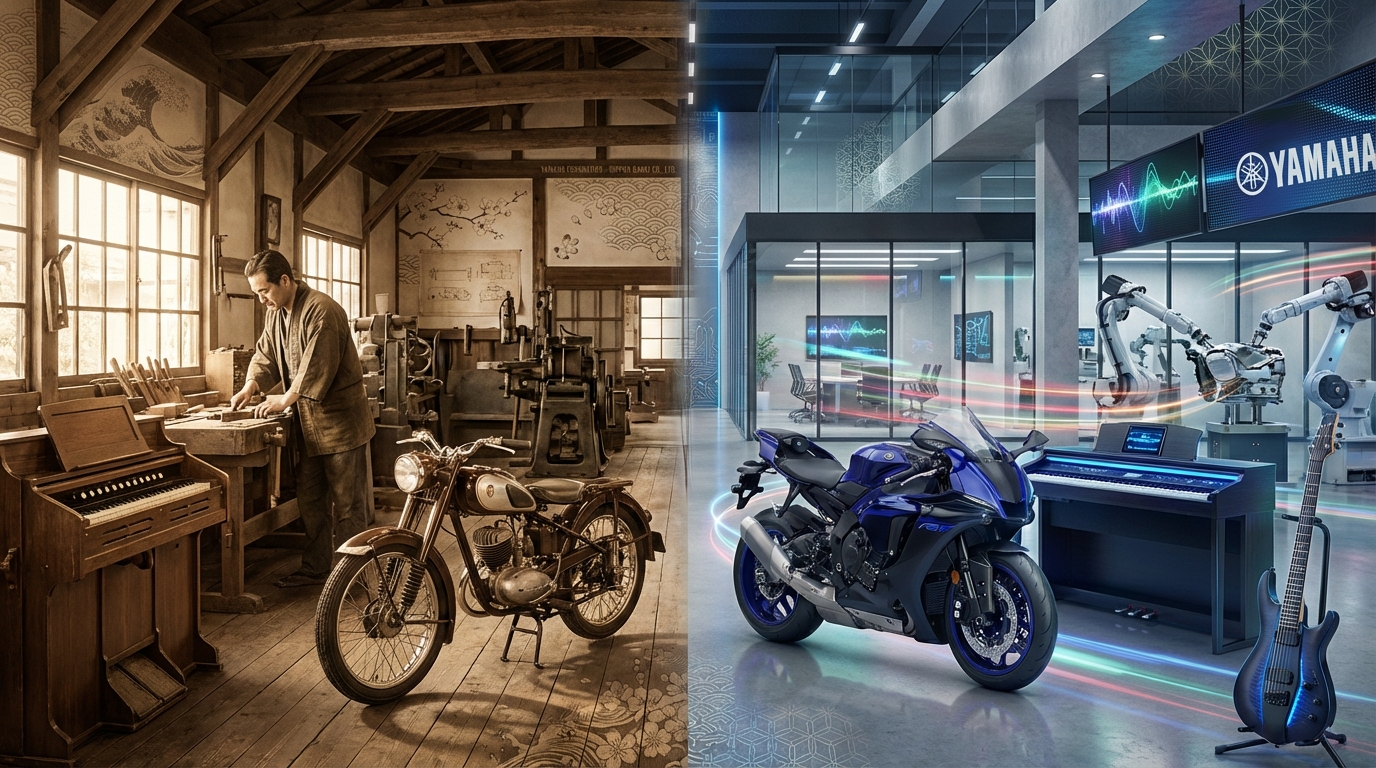
At the intersection of music and technology, the Yamaha brand stands out for its rich history and impressive evolution. From its humble beginnings in musical instrument manufacturing to its status as a global motorcycle giant, Yamaha embodies innovation and excellence. This Japanese company, founded at the end of the 19th century, has transcended sectors and conquered diverse markets thanks to a clear vision and remarkable technical mastery. The Yamaha adventure is the story of a bold and successful transformation, where the art of the tuning fork meets mechanical power with exceptional fluidity.
Exploring Yamaha’s roots is essential to understanding how this passion for music gave rise to technology capable of revolutionizing the world of two-wheelers. More than just a brand, Yamaha has become a symbol of continuous innovation and performance. Yamaha’s trajectory is also a testament to its ability to adapt to industrial developments and the expectations of its users, whether they are musicians, motorcyclists, or simply enthusiasts of mechanical thrills. In 2026, Yamaha remains, more than ever, a company in motion, combining heritage and cutting-edge technology to write the next chapters of a fascinating story.
Yamaha’s musical roots: a unique and visionary foundation
Yamaha’s origins are inextricably linked to its musical past. Founded in 1887 by Torakusu Yamaha, a watchmaker with a visionary spirit, the Yamaha Organ Manufacturing Company initially specialized in organ building. Its expertise in precision mechanics and acoustics quickly positioned the company among Japan’s leading musical instrument manufacturers. This first chapter inaugurated a true legacy built on quality and innovation.
This specialization in music is not insignificant. Yamaha built its first decade by developing advanced production techniques, where rigor and precision are fundamental, both to guarantee the purity of the sound and to optimize the reliability of the instruments. This mechanical expertise would prove crucial in the following decades, at a time when Yamaha was considering diversifying its activities. The fine mechanics used in organs created a natural bridge to the field of motorized engineering.
The strategic transition after the Second World War This marked a major milestone. Genichi Kawakami, president of Yamaha in the 1950s, decided to leverage this engineering expertise to launch motorcycle production, a decision that became the starting point of a new era. In 1955, Yamaha Motor Co., Ltd. was officially established. This turning point materialized with the release of the brand’s first motorcycle, the YA-1, whose build quality exceeded expectations in a rapidly expanding market.
- 1887: Foundation of Yamaha Organ Manufacturing Company for musical instruments.
- Development of expertise in precision mechanics and acoustics.
- After 1945: ambitious diversification towards the production of motorcycles.
- 1955: Official creation of Yamaha Motor Co. Ltd. and launch of the YA-1.
This deep connection between music and technology is fundamental to understanding Yamaha’s philosophy, which values aesthetics as much as performance, technical subtlety as much as mechanical robustness. This dual identity is reflected in its innovations, whether in instruments or motorcycles.
The 1950s-1960s: Promising beginnings and conquest of international runways
The 1950s marked a decisive turning point for Yamaha in the world of motorcycles. The YA-1, the brand’s first model, caused a sensation upon its release in 1955 thanks to its remarkable performance and exemplary reliability. Inspired by German models of the time, this 125cc two-stroke quickly gained notoriety, particularly after its victory in the famous Mount Fuji hill climb race that same year.
Encouraged by this success, the brand launched the YD-1 in 1957, a more powerful 250cc motorcycle designed to broaden its appeal. Yamaha then began exporting its motorcycles, establishing its presence in foreign markets. These early years were also marked by a growing interest in racing, vital for building the brand’s sporting reputation.
Innovation in racing and its impacts
The 1960s witnessed major technological advancements. Yamaha’s participation in Grand Prix racing from 1961 with the RD48 inaugurated a long tradition of track performance. Fumio Ito’s victory at Spa-Francorchamps in 1963, Yamaha’s first major international success, perfectly illustrates the Japanese firm’s growing strength.
A major milestone was reached in 1968 with the release of the DT-1, the first true production off-road motorcycle, equipped with a 250cc two-stroke engine. This machine pioneered dual-sport motorcycles, capable of handling both on-road and off-road riding with ease. Its resounding success, particularly in the United States, opened up a new segment and demonstrated Yamaha’s ability to innovate and diversify its product lines to meet evolving needs.
| Year | Model | Key Features | Impact |
|---|---|---|---|
| one thousand nine hundred fifty-five | YA-1 | 125cc, two-stroke, German quality | First victory, immediate recognition |
| one thousand nine hundred fifty-seven | YD-1 | 250cc, two-stroke | Product range expansion, start of exports |
| one thousand nine hundred sixty-one | RD48 | 250cc, Grand Prix motorcycle | First participation in the world competition |
| one thousand nine hundred sixty-eight | DT-1 | 250cc, the first dual-sport motorcycle | Popularization of off-road vehicles and versatility |
This period saw Yamaha establish a lasting presence on the international stage, based on a strategy combining product innovation and competition. Yamaha was no longer just a Japanese manufacturer: it was a brand that began to shape global motorcycle culture.
The 1970s-1980s: Diversification and major technological innovations
The 1970s marked a diversification of Yamaha models, notably with the launch of their first four-stroke motorcycle, the XS-1, in 1970. This machine, with its 650cc parallel-twin engine, paved the way for a new market segment focused on high-performance family road bikes. This turning point was decisive and positioned Yamaha as a versatile and dynamic player.
The brand also achieved international glory in racing thanks to Kenny Roberts, who dominated the 500cc class. Roberts won the world championship three times in the late 1970s and established Yamaha as a dominant force in MotoGP, thus reinforcing the brand’s sporting legend. These competitive successes served as both marketing tools and veritable laboratories for technical innovations.
Technological explosion in the 1980s
The 1980s were a decade ripe for technological advancements, with Yamaha skillfully combining performance and comfort. In 1984, the FJ1100, a sport-touring motorcycle, demonstrated Yamaha’s ability to create powerful machines while offering excellent comfort for long distances.
In 1985, the legendary VMAX was born, embodying pure raw performance with its 1200cc V4 engine and aggressive design. The VMAX became an icon, a symbol of an era in which technical and stylistic audacity were fully asserted.
With the launch of the FZR1000 in 1987, Yamaha further solidified its reputation for sportiness with an advanced machine, setting new standards in handling and power. These innovations perfectly illustrate the link between competition, technology, and user experience.
Modern successes: innovations and competitive performance
The period from the 1990s to the early 2000s saw Yamaha continue its pursuit of innovation and sporting dominance. The introduction in 1998 of the YZF-R1, a lightweight and powerful sport bike, marked a turning point in this category with its 1000cc inline four-cylinder engine. It profoundly influenced the supersport market and remains an essential benchmark.
In competition, Yamaha continues to excel with champions like Wayne Rainey in the 1990s and especially Valentino Rossi, who joined Yamaha in 2004. Rossi ended Honda’s dominance by winning several world titles with Yamaha and helped strengthen the brand’s sporting prestige. His influence extends beyond the track, inspiring generations of motorcyclists.
The technical advancements didn’t stop there: in 2009, Yamaha unveiled a second generation of the VMAX, more powerful and equipped with a 1700cc V4 engine. This version also benefited from electronic advancements that appealed to thrill-seekers. Furthermore, Yamaha continued to develop its off-road range with highly regarded models such as the WR250R.
To discover the detailed specifications and current prices of Yamaha models, it is worth consulting resources like this one. Complete guide to Yamaha 2026 models and the detailed technical specifications of the Yamaha MT-09, which clearly illustrate the constant evolution of the brand’s products.
Innovation and environmental commitment: Yamaha’s challenges in the contemporary era
Entering the 2010s and beyond, Yamaha has demonstrated a firm commitment to embracing cutting-edge technologies while also adopting a stronger focus on sustainability. The 2015 release of the YZF-R1M perfectly illustrates this ambition, featuring high-performance components derived from MotoGP racing, representing the pinnacle of handling and advanced technology.
In the context of the ecological transition, Yamaha is also investing in innovative solutions such as the NIKEN, a three-wheeled motorcycle equipped with a revolutionary front suspension system. This machine optimizes stability and safety, while symbolizing the technological boldness needed to meet modern mobility needs.
In parallel, Yamaha is developing several projects around electric and hybrid powertrains. The E01 electric scooter is a prime example, representing the company’s commitment to reducing its carbon footprint while maintaining the practicality and performance expected by users. This strategy reflects the vision of a constantly evolving company, where innovation is at the heart of its philosophy.
On the sporting front, Yamaha maintains a strong presence in MotoGP. In 2021, Fabio Quartararo secured the world championship, confirming that the brand, despite recent challenges, remains competitive. Yamaha is actively working to improve its machines and plans to intensify its technical development to continue its success.
| Year | Innovation / Model | Features | Meaning |
|---|---|---|---|
| two thousand fifteen | YZF-R1M | MotoGP technologies, ultra-lightweight | Cutting-edge technology and extreme performance |
| two thousand eighteen | NIKEN | Three wheels, innovative front suspension | Stability and new mobility |
| two thousand twenty | E01 Electric Scooter | Electric motor, modern design | Ecological commitment and urban mobility |
| two thousand twenty-one | Fabio Quartararo | MotoGP champion | Major sporting success, continuous innovation |
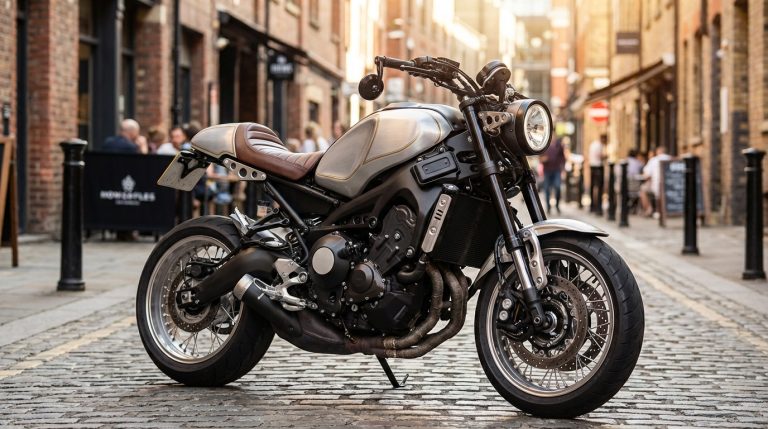
To delve deeper into these advances, the complete test of the YZF-R1 2026 and a look at the Yamaha XSR 900 retro-sport allows one to fully appreciate the blend of heritage and innovation that characterizes the Japanese brand.
When was Yamaha founded and what was its first product?
Yamaha was founded in 1887 by Torakusu Yamaha. Originally, the company specialized in the manufacture of musical instruments, particularly organs.
What was the first motorcycle launched by Yamaha and what were its performance figures?
The first Yamaha motorcycle was the YA-1, launched in 1955. It was a 125cc two-stroke inspired by German models, renowned for its quality and performance, notably with its victory in the Mount Fuji climb the same year.
How did Yamaha integrate competition into its development?
Yamaha entered Grand Prix racing in 1961 and achieved its first victory in 1963 at Spa-Francorchamps. Successes in competition, such as those of Kenny Roberts and Valentino Rossi, solidified its reputation and influenced its innovations.
What are some recent iconic Yamaha models that exemplify innovation?
The YZF-R1M released in 2015, the NIKEN three-wheeled motorcycle of 2018, and the E01 electric scooter are recent examples that show Yamaha’s commitment to high technology and sustainability.
Where can I find detailed information on current Yamaha models?
Comprehensive guides and technical specifications, such as those offered on moto-mag.net, provide up-to-date information on Yamaha models in 2026, including the MT-09 or the XSR 900.